
Skip to content
Masaki Shiraishi

Masaki Shiraishi

Quantum Algorithm & ML Engineer

Working at the intersection of quantum computing and machine learning, with a focus on implementation and real-world impact.

Currently

  • Developer, MITOU Target Program — Quantum Computing · Innovation Platform Agency, Japan (IPA)
  • B.Eng. in Applied Physics · Waseda University
Portrait of Masaki Shiraishi
Recent

Selected

  1. Oct 2026 · Award

    LeapFrog Award

    NEDO Challenge, Quantum computing “Solve Social Issues!” (granted by Japan’s Ministry of Economy, Trade and Industry)

  2. Aug 2026 · Nature
  3. Jun 2026 · Award

    MITOU Target Program — Quantum Computing

    Innovation Platform Agency, Japan (IPA)

01

Research

AI Agents for Quantum Computing

Giving language-model agents the ability to actually run and design quantum programs, not just write code that looks plausible.

Most work on AI for science stops at generating code. The harder problem is execution: a quantum workload has to be compiled, scheduled across QPUs and HPC clusters, and run asynchronously on remote hardware before anyone learns whether the idea was any good.

My QCNC 2026 paper closes part of that gap with a Model Context Protocol server for quantum execution, letting an agent invoke sampling and expectation-value primitives directly against the ABCI-Q hybrid platform and remote hardware. The MITOU Target project extends the same idea from execution to design — an agent platform that assembles quantum circuits itself.

LLM agents · Model Context Protocol · CUDA-Q · OpenQASM · quantum-HPC
Quantum Algorithms and Resource Estimation

Implementing textbook algorithms at circuit level, where the interesting question is what they actually cost.

I worked on solving the elliptic-curve discrete logarithm problem with Shor’s algorithm during my time at BlocQ. An algorithm that is polynomial on paper can still be far out of reach in qubit count, T-gate count and circuit depth, and the gap between those two facts is where the engineering lives.

I am interested in implementations concrete enough to be counted — and in what those counts imply for how much time cryptography actually has.

Shor's algorithm · ECDLP · circuit optimization · resource estimation

Quantum Computing for Machine Learning and Optimization

The input problem: quantum advantage arguments tend to assume the data is already inside the machine.

At the University of Osaka’s Quantum Software Research Hub I worked on loading classical data into quantum circuits — a step that is easy to gloss over and expensive enough to erase the speedup it was meant to enable.

At JIJ I looked at the other end of the same pipeline, applying quantum computing to operations research and machine learning problems where the question is whether a hybrid method beats a good classical baseline at all.

data loading · state preparation · operations research · hybrid methods

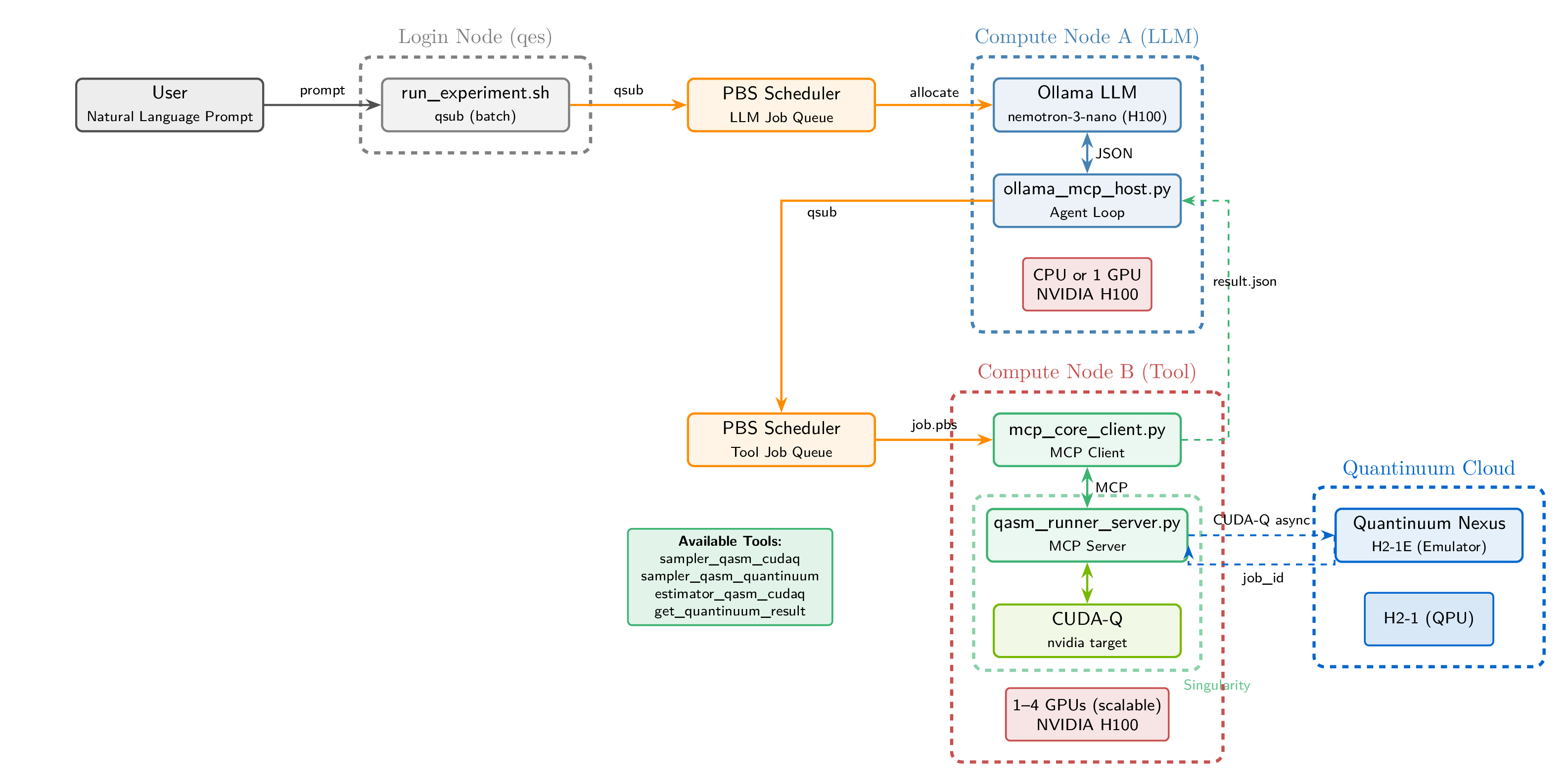
Architecture diagram. A natural-language prompt from the user enters run_experiment.sh on the login node, which submits an LLM job via the PBS scheduler to compute node A, where an Ollama LLM drives an MCP host agent. The agent submits a second PBS job to compute node B, where an MCP client and QASM runner server execute circuits through CUDA-Q or dispatch them asynchronously to the Quantinuum Nexus H2-1E emulator, returning results as JSON.
Fig. 1 Two-stage PBS batch architecture. The LLM job runs on one compute node; quantum execution is dispatched as a separate PBS job to a CUDA-Q node or the Quantinuum cloud. arXiv:2604.08318Click to view at full size.
Quoted

not yet a fully autonomous scientist

02

Publications

QC4C3 Workshop @ IEEE QCNC 2026 · accepted

A Model Context Protocol Server for Quantum Execution in Hybrid Quantum-HPC Environments

Masaki Shiraishi, Ikko Hamamura, Tatsuya Ishigaki, Tadashi Kadowaki

QC4C3 Workshop, IEEE International Conference on Quantum Communications, Networking, and Computing (QCNC), 2026

Abstract +

The integration of large language models (LLMs) into scientific research is accelerating the realization of autonomous "AI Scientists." While recent advancements have empowered AI to formulate hypotheses and design experiments, a critical gap remains in the execution of these tasks, particularly in the domain of quantum computing (QC). Executing quantum algorithms requires not only generating code but also managing complex computational resources such as QPUs and high-performance computing (HPC) clusters. In this paper, we propose an AI-driven framework specifically designed to bridge this execution gap through the implementation of a Model Context Protocol (MCP) server. Our system enables an LLM agent to process natural language prompts submitted as part of a job, autonomously executing quantum computing workflows by invoking our tools via the MCP. We demonstrate the framework's capability by performing essential quantum algorithmic primitives, including sampling and computation of expectation values. Key technical contributions include the development of an MCP server for quantum execution, a pipeline for interpreting OpenQASM code, an automated workflow with CUDA-Q for the ABCI-Q hybrid platform, and an asynchronous execution pipeline for remote quantum hardware using the Quantinuum emulator via CUDA-Q. This work validates that AI agents can effectively abstract the complexities of hardware interaction through an MCP-based architecture, thereby facilitating the automation of practical quantum research.

arXiv:2604.08318IEEE Xplore
03

Talks

27 February 2026

An AI-Driven Automated Execution Pipeline for Quantum Computing

AIによる量子計算の自動実行パイプライン

4th G-QuATaaaalk — Incubation Networking Event

第4回 G-QuATaaaalk インキュベーション交流会

Global Research and Development Center for Business by Quantum-AI Technology (G-QuAT), AIST · AIST Tsukuba, Japan

A centre of the National Institute of Advanced Industrial Science and Technology, Japan’s national research institute for industrial science.

On the AI-driven quantum execution work behind my QCNC 2026 paper.

04

Media

05

Experience

  1. Jun 2026 — Present

    Developer, MITOU Target Program — Quantum Computing

    Innovation Platform Agency, Japan (IPA) · Tokyo, Japan

    An incorporated administrative agency under the Ministry of Economy, Trade and Industry (METI).

    AI for quantum computing

  2. Mar 2026 — May 2026

    Quantum Algorithm Researcher

    Jij Inc. · Tokyo, Japan

    Quantum computing for operations research and machine learning

  3. Oct 2025 — Feb 2026

    Research Intern

    The University of Osaka · Quantum Software Research Hub · Osaka, Japan

    Loading classical data into quantum circuits

  4. Sept 2025 — Nov 2025

    Lead Organizer, Qiskit Fall Fest 2025

    IBM · Tokyo, Japan

    Organized a university-wide quantum computing workshop as part of the global Qiskit Fall Fest

  5. Apr 2025 — Sept 2025

    Quantum Algorithms Research Intern

    BlocQ, Inc. · Tokyo, Japan

    Solving the ECDLP using Shor’s algorithm

  6. Apr 2024 — Mar 2028

    B.Eng. in Applied Physics

    Waseda University · School of Advanced Science and Engineering · Tokyo, Japan

    Currently in the third year

06

Awards & Programs

  1. 2026

    LeapFrog Award

    NEDO Challenge, Quantum computing “Solve Social Issues!” (granted by Japan’s Ministry of Economy, Trade and Industry)

    NEDO懸賞金活用型プログラム/量子コンピュータを用いた社会問題ソリューション開発

    NEDO (New Energy and Industrial Technology Development Organization) under Japan’s Ministry of Economy, Trade and Industry

    An individual award, received for my contribution to a team entry in the Society 5.0 theme of this national prize-money program, which funds results that address social and industrial problems using quantum computers.

  2. 2026

    MITOU Target Program — Quantum Computing

    未踏ターゲット事業(量子コンピューティング)

    Innovation Platform Agency, Japan (IPA)

    An incorporated administrative agency under the Ministry of Economy, Trade and Industry (METI).

    Selected as a developer in this national R&D program for the project “Quantum-Circuit Automatic Design Agent Platform with MCP Integration” (MCP連携による量子回路自動設計エージェント基盤), under project manager Naoki Yamamoto (Director, Keio University Quantum Computing Center).

07

Contact

Feel free to reach out for collaboration or discussion.